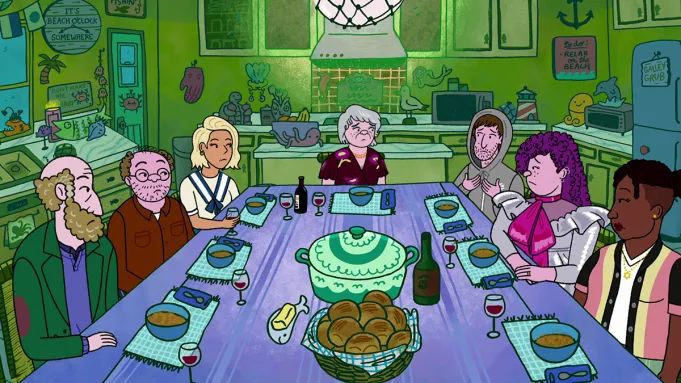
Food is a great way to connect with people, and making food together can help to amplify that. It’s also a wonderful way to appreciate another culture. Recently, I learned to make knish, a traditional Eastern European Jewish pastry. This atmosphere was the core for the Long Story Short cooking event, where creator Raphael Bob-Waksberg (BoJack Horseman creator) and actress Lisa Edelstein, who voices Naomi Schwartz, invited guests to learn to cook a Jewish pastry and discuss family, memory, and the themes featured in the series.
Netflix’s Long Story Short is an animated series that follows a Jewish family, particularly the three siblings, told in a nonlinear fashion. For the cooking event, it captured the spirit of the show as we joked and shared stories, and the hosts discussed memories, Jewish humor, grief, and how storytelling can help people to understand one another.
“What better way to remember things than food?” Bob-Waksberg said during the cooking session. “And what better way to remember family than food? It’s what the episodes are about, and that’s what today is all about.”
Lisa Edelstein added to the topic about how cooking traditions can be vital to families.
“Making food with your family, all those moments are so important,” Edelstein said. “They’re the little things that actually create and sort of capture your life.”
The event focused on learning to make knish, but it helped to open up about storytelling, identity, and empathy.
During the interview portion of the event, I discussed how the show’s lesson helped people to understand one another. Bob-Waksberg explained that even though Long Story Short is about a Jewish family, the goal was never to make something that felt exclusionary.
“I would hope that this is a show that doesn’t feel narrowly focused,” Bob-Waksberg said. “That people from all backgrounds could kind of come to it and see themselves in it, even if the specifics don’t apply, but also maybe learn something about a different kind of person perhaps.”
Edelstein added that a story’s specificity helps it become universal.
“Through the specificity of making a Jewish family, [Bob-Waksberg] is hoping to actually speak to everybody,” Edelstein said. “But you can’t pretend to be everybody to do that. You have to really dig into the culture that you’re representing.”
The interview topics included history, suffering, and why it’s important to learn about difficult times. This resulted in discussing a personal story about wanting to visit concentration camps in Poland to better understand history and being surprised by a family member’s dismissive reaction.
“If the lesson you take away is, ‘Here’s a bad thing that happened to us,’ and that’s all you take away from it, then you’re missing something,” Bob-Waksberg added. “This is what humans are capable of doing.”
Long Story Short features characters across different decades, showing how they have changed while still showing how they have remained the same. Audiences get to see how certain characters meet others for the first time, and how it can affect their lives.
“The way [Bob-Waksberg] tells the stories is sort of like the way you make friends with somebody,” Edelstein said. “You jump from story to story when you’re excited about meeting somebody new. You go from this time to that time – ‘Well, when I was a kid…’ and then later on. That’s kind of how memory works.”
“Writing about these characters at different times does force us to make choices and learn new things about them,” Bob-Waksberg added. “These characters are consistent across the run of the show. They are who they are, but you also see some of them gain confidence, while others gain resentment.”
Even when discussing heavier topics, the event’s atmosphere was light and warm overall. This was a perfect example of how Long Story Short balances humor and drama. In the end, the knish was eaten, but the takeaway is how memory, culture, and empathy can connect people.