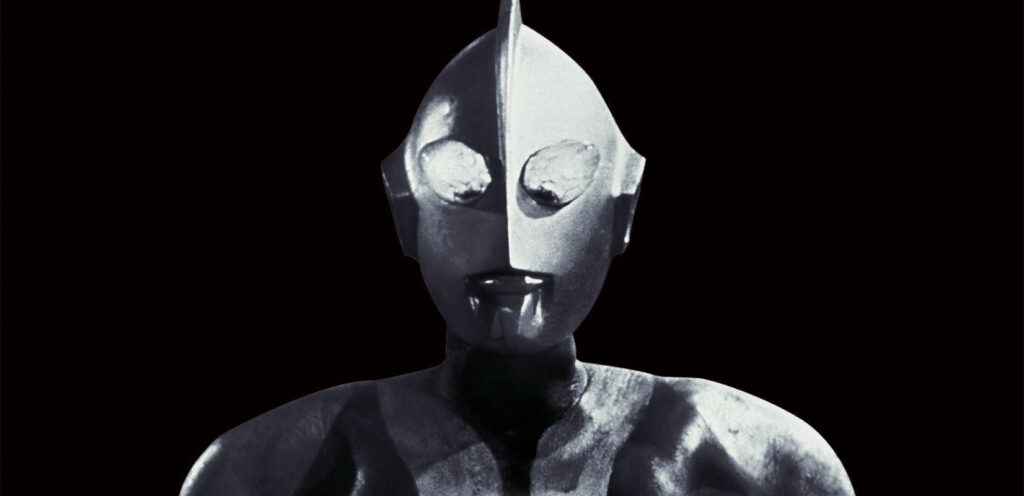
Ultraman has been saving Japan from giant monsters since 1966, when special-effects pioneer Eiji Tsuburaya followed the success of Ultra Q with a new television hero: Ultraman. The first 39-episode series helped turn tokusatsu (live-action fantasy built around elaborate practical effects) into a television institution. Six decades of sequels, reinventions, toys, films, and international fandom followed. Marking its official 60th anniversary, The Origin of Ultraman arrives less as a complete history lesson than as a collection of people trying to explain why this strange, compassionate giant never left them.
At the center sits Eiji Tsuburaya. The documentary repeatedly returns to the punishing labor behind the original’s production: miniature cities, creature suits, optical effects, detailed designs, and weekly television deadlines that called for movie-scale imagination at an unforgiving pace. Archival footage from the shoots and clips from iconic episodes reveal the handmade ingenuity involved. By the end, The Origin of Ultraman feels as much like a tribute to Tsuburaya—the “Father of Tokusatsu”—as it does to Ultraman himself.
Still, anyone expecting a chronological account covering every Ultra hero, production shift, or major era will leave with gaps. Directors Yu Nakamura and Kazutaka Yoshida are more interested in passion than documentation, and it’s easy to see why. Their interview lineup is remarkable: Guillermo del Toro, Hideo Kojima, Hideaki Anno, Hirokazu Koreeda, and Nicolas Winding Refn—just to name a few. Together, they approach Ultraman as a mythology, childhood memory, religious symbol, design object, and creative trigger.
The interviews are terrific because every interviewee openly talks about how much they love the character. Refn discusses Ultraman with pure excitement, like a kid talking about firetrucks, while Kojima describes believing in Ultraman almost as one might believe in God. That kind of enthusiasm becomes infectious.
The Origin of Ultraman honors Eiji Tsuburaya and six decades of tokusatsu history through archival footage and deeply personal interviews.
The conversations become even richer when they move beyond nostalgia. Del Toro and Koreeda compare Catholic and East Asian religious traditions while discussing why they believe Ultraman connected so strongly with audiences in Mexico but never became equally embedded in the United States. Original Ultra Q and Ultraman star Hiroko Sakurai gives a more intimate connection to the people who built the phenomenon. Taken together, these perspectives turn the documentary into something larger than franchise promotion, and it becomes an exploration of how popular art travels, changes meaning, and settles into people’s inner lives.
Unfortunately, the filmmaking rarely equals the quality of its material. This is an official Tsuburaya production distributed by TOHO NEXT and Tsuburaya Productions, yet it often looks strangely amateurish. Onscreen text changes style and position without much logic. Names can be difficult to locate, subtitles occasionally compete with other graphics, and transitions between speakers feel clunky. Classic footage and archival material are welcome, but clips sometimes begin or end at awkward points, interrupting thoughts rather than extending them. The problem is not a lack of access. It’s a lack of polish.
That becomes frustrating because the raw material is so strong. A cleaner edit could have created a sweeping cultural history worthy of the anniversary. Instead, the production occasionally resembles an excellent collection of bonus features assembled without enough attention to rhythm. Even so, the film’s affection shines through, and the images, memories, and thoughtful comments help explain why Ultraman has lasted so long.
Overall, The Origin of Ultraman might not be the ultimate documentary as its official label suggests. Still, it does capture something special: the joy on someone’s face when an old hero makes them feel like a child again.
Rating: 3/5 atoms