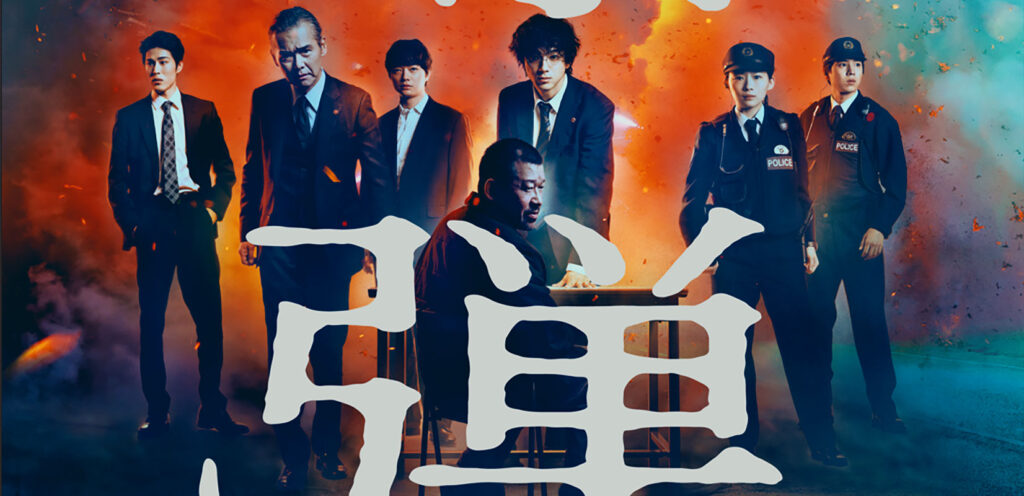
Suzuki=Bakudan understands that the most frightening person in the room is not always the one you suspect. Sometimes it’s the man sitting in a chair, half-conscious, answering questions as if he wandered into the wrong police station. That uncertainty drives this enthralling film, and rarely lets the audience get comfortable.
The setup follows Suzuki, a seemingly pathetic drunken vagrant, who is brought in for questioning. After using his (supposedly) psychic abilities to predict tragedies, he becomes linked to a series of bombings across Tokyo. Most of the film unfolds inside a cramped interrogation room, where officers try to determine whether Suzuki is a legitimate psychic or the person behind these bombings.
That might sound boring on paper, but Jiro Sato is the reason it works. His performance begins so understated that Suzuki almost seems harmless. Then, little by little, the mask slips. Before long, the man who looked barely capable of standing begins studying the shadowy aspects of everyone around him. Sato moves between desperation, smug amusement, wounded pride, and genuine menace so easily that it becomes difficult to tell where the performance ends and Suzuki’s manipulation begins.
Suzuki=Bakudan transforms a largely static interrogation into a white-knuckle thriller filled with manipulation, uncertainty, and escalating chaos.
The film contrasts these mostly static interrogations with the frantic movement of Tokyo outside. Police race through crowded city areas as the bomb threat expands, while the two officers who arrested Suzuki begin their own investigation. These scenes provide a welcome release from the interrogation room, yet never reduce the pressure. Instead, every cut back to Suzuki feels like returning to the source of these problems.
What begins as a contained mystery steadily snowballs. As the stakes rise, Suzuki’s riddles become harder to solve. He may be a psychic or a terrorist, and the film understands that explaining him too neatly would make him less frightening.
There is a guilty pleasure in watching a truly magnetic villain—or possible villain—operate. Characters like Suzuki embody impulses most people would never voice, frustrations that civilized society demands we bury. He exposes those feelings in others and appears delighted by what he finds. That makes him more than a puzzle for the police to solve. He’s a mirror they would rather smash.
Overall, Suzuki=Bakudan is a white-knuckle psychological thriller that’s intimate and explosive at the same time. It’s held together by Jiro Sato’s fearless performance and the unnerving possibility that the most dangerous bomb in Tokyo may be the most confident person in an interrogation room.
Rating: 4/5 atoms