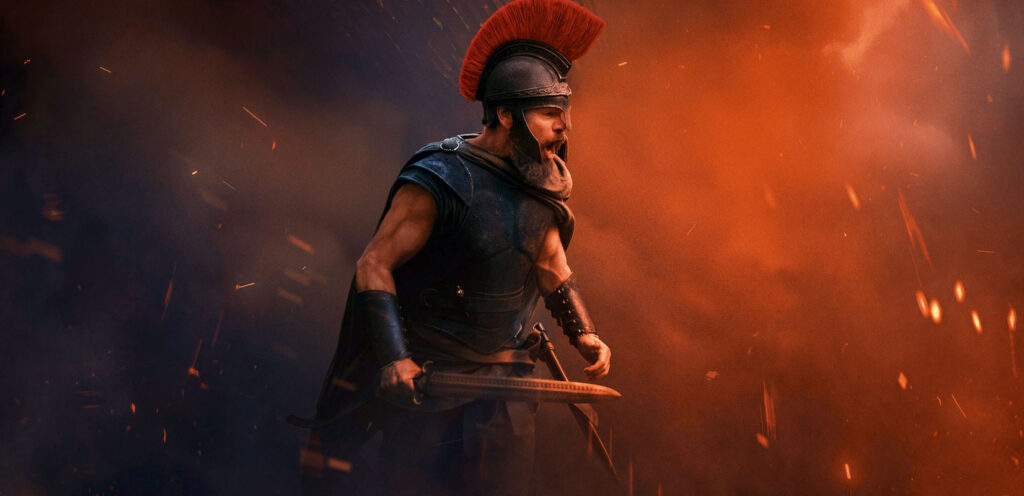
Few stories have survived, evolved, and influenced popular culture like The Odyssey. Composed nearly three thousand years ago and traditionally attributed to the ancient Greek poet Homer, the epic follows Odysseus as he tries to return home after the Trojan War. What should be a straightforward voyage to Ithaca becomes a decade-long struggle involving angry gods, seductive immortals, dangerous creatures, and one terrible decision after another. Yet the story’s lasting power comes from more than its monsters and myths. Beneath the mythology lies a human story about the damage people carry after war and whether someone can ever truly reclaim the life they left behind. Nolan’s The Odyssey makes that central idea feel more timely than ever.
On the surface, this is a fantastical sword-and-sandals epic under Christopher Nolan’s guidance. There are creatures, gods, magic, battles, and enormous environments that make Odysseus seem almost impossibly small. Yet Nolan never lets the spectacle take over completely. No matter how strange or intense the journey gets, the world feels physical. The danger has weight. Every storm, wound, and loss feels real rather than something brushed aside once the next set piece begins.
That grounded quality makes the movie work so well. Nolan understands the appeal of showing Odysseus facing legendary monsters on the largest screen, but this film is more interested in the human cost than in mythology. Its creatures may be memorable, yet the emotional consequences of meeting them linger longer.
The film does take creative liberties with material that has been studied, translated, and argued over for centuries. Purists will undoubtedly find choices to debate. Still, Nolan does not treat Homer’s poem like an untouchable museum piece. Instead, he reshapes it into something cinematic, accessible, and unexpectedly relevant without taking away what made the original endure in the first place. Someone unfamiliar with The Odyssey can follow the film without feeling as though they should have completed a classics course beforehand. At the same time, it may leave those viewers curious enough to seek out the original Greek literature and discover what was changed, condensed, or reinterpreted.
Christopher Nolan delivers a visually staggering adaptation of The Odyssey that finds fresh relevance and real humanity within Homer’s ancient epic.
In many ways, Nolan’s version shares thematic DNA with Oppenheimer. Once again, he is fascinated by legacy, regret, loss, and the distance between how a man views himself and how history may remember him. Odysseus is a hero, but the film questions what that word actually means. His intelligence repeatedly saves him, though his pride exacts a cost others often pay.
Those ideas fit naturally alongside themes central to The Odyssey—particularly homecoming and the ancient Greek concept of guest-friendship. Hospitality can be an act of compassion. In ancient Greece, it can also test character or leave a person dangerously exposed. Nolan uses those traditions to depict a world where goodwill still matters, even when cruelty feels easier. As a result, the journey gains another level of tension and feels connected to the present rather than locked in the distant past.
The cast is excellent across the board. Even actors with limited screen time make their characters feel as if they existed long before Odysseus arrived and will continue to live after he leaves. More importantly, the performances keep the film emotionally grounded. Odysseus may be undertaking one of the grandest journeys ever told, but every person he meets is undertaking a journey of their own.
Visually, The Odyssey is phenomenal. In IMAX 70MM, the landscapes, ships, battles, and mythological encounters carry a scale that is a sight to behold. The sound design is just as impressive. Nolan surrounds the audience with crashing waves, breaking wood, distant voices, and moments of silence that feel just as overwhelming.
Yet for all its technical ambition, Nolan never forgets what Odysseus is fighting to reach: home.
That is what makes The Odyssey more than a beautifully constructed mythological epic. It’s a story about surviving long enough to return to the people you love, then confronting the uncomfortable possibility that neither you nor the home you remember has remained unchanged. Nearly three thousand years later, that journey still hits with remarkable force.
Rating: 5/5 atoms