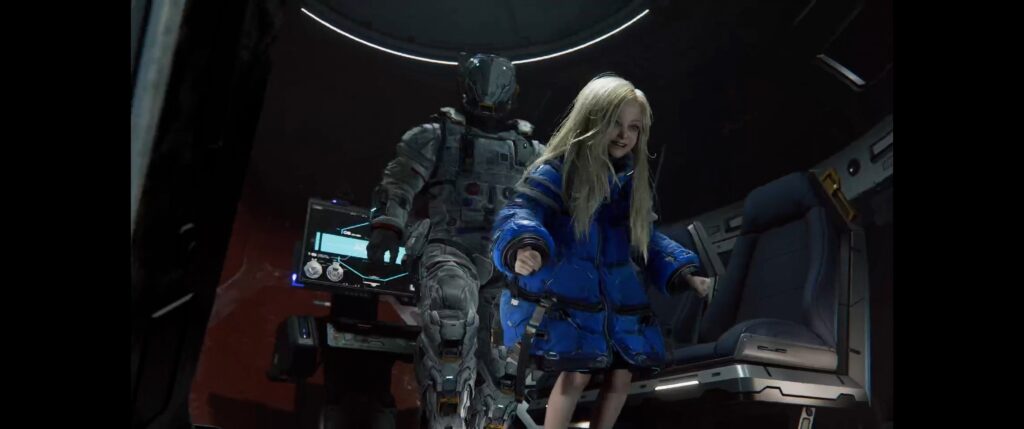
Capcom’s newest game is almost here! Pragmata is a third-person action-adventure game built in the RE Engine. What makes it unique is the combination of third-person shooting with simple puzzles to create a unique gameplay experience. However, it is an experience that may not be for everyone, as it revolves around a particular gimmick that either will or will not click for the player. This gameplay is intertwined with a heartfelt journey of the two main characters.
The Story
The story of Pragmata features the protagonist Hugh Williams, a space soldier, who goes to the moon to figure out what exactly happened there. Hugh finds an android in the form of a little girl, named Diana. She is a Pragmata, which is officially defined as “A high-functioning autonomous prosthetic body with a simulated organic structure.”
Together, these characters team up and create a special relationship. One of the best parts of the game is seeing their special relationship grow. Hugh is someone who never really thought about being a father and has to take care of Diana, an innocent child who only wants to help. So many great father-daughter-like moments are scattered throughout the game in both the main story and side dialogue.
The story outside of the relationship is solid, but could have been better. It is a story where it is best to know as little as possible going into it. But it can be easily described as an unraveling mystery. The game does give answers by the end. For any lore junkies, there are lots of notes to be found, which also help expand and explain exactly what’s going on outside of the cutscenes and dialogue.
Enemies
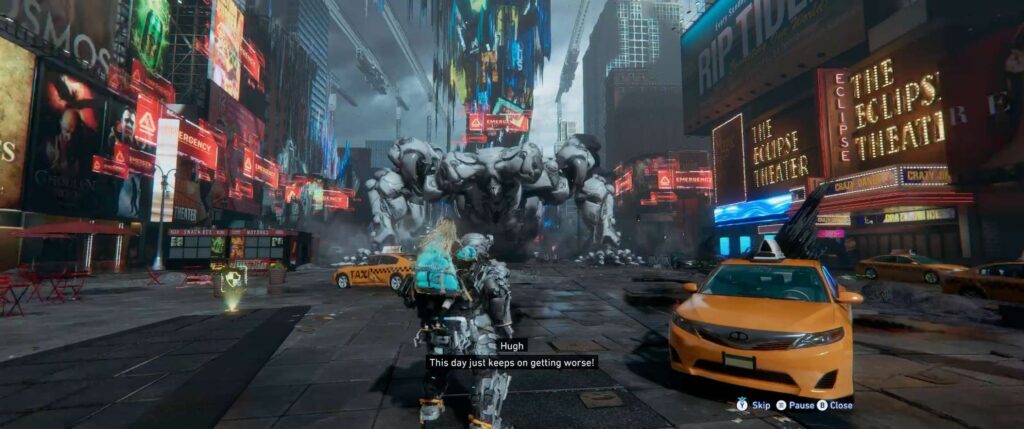
While unraveling the mystery, Hugh and Diana face off against a good variety of enemies featured throughout the game as well. All the enemies are different kinds of robots that range from basic humanoid models to bigger robotic warriors to flying enemies. Between fighting basic enemies and stronger enemies, there’s a solid progression of difficulty. Enemies get stronger as the game goes on.
The gameplay features the player controlling Hugh while also using Diana’s abilities. Hugh focuses on shooting and movement. The combat involves using four different types of weapons or gadgets, each with its own role. First, there’s the basic weapon that has unlimited ammo and a cool-down on use. Then there’s a stronger weapon, which is used to pack a bigger punch, also with a cool down, but it has limited uses. The gunplay is simple compared to other games, but it pairs nicely with the hacking mechanic. The other 2 kinds of weapon slots are gadgets used to help distract enemies and aid in combat. These all have limited uses as well.
Hacking and Shooting
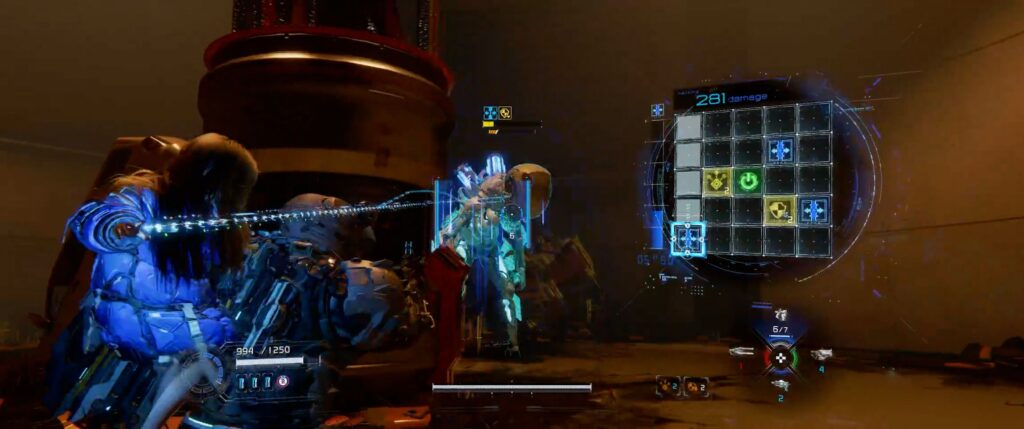
The variety of weapons and gadgets is only half of what’s involved in the combat. What really sets this game apart from other games is the hacking feature. This feature is essential in letting the player deal damage, and to do so, it involves hacking puzzles while fighting. The puzzles are simple, where it’s on different grid shapes depending on the enemy, and you have to make a line to go to the end. These hacking puzzles feel really satisfying on a controller, as it makes use of the action buttons on a controller to control the puzzle movement. This leaves movement, dodging, and shooting skills available to use at the same time. However, the controls don’t feel nearly as intuitive on keyboard and mouse.
The balance of handling both not getting hit and doing puzzles is tough. What adds another layer to this is the use of nodes during hacking. Special, limited-use abilities that are used during the hacking part of combat. This adds more depth as, due to their limited uses. The player would want to make sure not to use them on weaker enemies, but on the stronger enemies. This constant balance of figuring out puzzles while dealing with enemies makes for very fun and unique gameplay. However, it is also a different flavor of gameplay, which will most likely be an acquired taste and not for everyone.
The game takes a more tactical approach with resource management, such as when to use certain guns, gadgets, hacking nodes, and movement. The movement is similar to other third-person action shooters, but features a dash ability that takes stamina. This means stamina has to be managed as well when fighting enemies. This makes it feel sluggish compared to other third-person action shooters. Although in this case, describing the overall movement as sluggish is not bad, as it lends itself to the tactical action gameplay approach.
Exploration
One of the best parts of the game is the exploration of the areas. The whole game is set on a massive space station that rewards exploration, with upgrades and unlockables to be found. The game also helps track how many collectibles are left in each area, which is satisfying when exploring all the areas fully. Also, a really cool detail is that when going to previously completed areas, there’s new dialogue between Hugh and Diana. This adds even more depth to their relationship and allows for the impact of certain story moments to simmer.
Side Content
Outside of the story and exploration, the game offers other side content, such as special challenges and similar content, after the story ends. This is a surprising welcome addition, as some of these challenges differ from the game’s normal challenges. These include having to use certain weapons in a certain way or to complete parkour courses. Completing everything can easily double the playtime put into the game. From personal experience, the final playtime after playing everything is over 21 hours. Playing just the story would probably take about half as long, or more if spending time on exploration.
Final Reaction
Pragmata offers a different flavor of gameplay that may not click for everyone. But it offers a unique experience to help stand out in a market that is oversaturated. This game has a cool gimmick combining puzzles and third-person shooting that would be awesome to see expanded upon, regardless of whether it’s being made by Capcom or the next great indie game. Pragmata is another Capcom game that’s definitely worth playing and has the potential to become a cult classic.
Pragmata will be available on Steam, PlayStation 5, Xbox Series X/S, and Nintendo Switch 2. The game releases on April 17th.